Planning
How Much Does Wedding Photography Cost in Guntur? What Affects the Price
Quotes from Guntur studios can look very far apart. Here is what actually drives the cost of wedding photography and video, and how to compare quotes fairly.
It is usually the second question families ask, right after “Are you free on our date?” — and it is a fair one. Wedding photography is one of the larger expenses of a Telugu wedding, and quotes from different studios in Guntur can look very far apart. One studio’s figure seems too low to be real, another’s seems impossible, and it is hard to tell whether they are even offering the same thing.
This guide won’t give you a price list, because an honest one doesn’t exist. What it will do is explain exactly what drives the cost of wedding photography and video, so you can read any quote — ours or anyone else’s — and understand what you are paying for.
Why there is no single price
Two weddings on the same muhurtham date in Guntur can need completely different coverage. One family wants the muhurtham and a reception in the same hall on the same day. Another has Pellikuturu and Pellikoduku ceremonies at two homes, a sangeet, a night muhurtham, Vratham the next morning and a reception in Vijayawada two days later.
Both are “a wedding”. But the second needs more people, more hours, more travel and far more editing. A fixed package price would either overcharge the first family or leave the second badly under-covered. That is why most serious studios — including ours — prefer to quote after understanding your events, rather than before.
The cost comes down to a handful of factors. Once you know them, quotes become much easier to compare.
How many events you want covered
This is the single biggest factor. Every event means a team travelling, setting up, shooting and later editing. A typical Telugu wedding can include:
- Engagement or nischitartham, sometimes months earlier
- A pre-wedding shoot
- Pellikuturu and Pellikoduku ceremonies, often at two separate homes
- Mehendi or sangeet
- The wedding itself — Snathakam, Kashi Yatra, Gauri Puja, the muhurtham, Talambralu and Appagintalu
- Vratham or Satyanarayana Swamy puja
- The reception
Write down every event you are planning, with the date, place and rough timing, before you ask for quotes. It is the most useful thing you can do, and it lets studios quote like-for-like. If you are not sure which events are worth covering, our Telugu wedding photography timeline walks through them ritual by ritual.
Hours of coverage and your muhurtham time
A muhurtham at nine in the morning and one at three in the morning are very different jobs. Early or late muhurthams mean the team arrives hours before, often works through the night, and sometimes needs a place to rest before the next event. Long wedding days — getting ready in the morning, muhurtham in the afternoon, reception in the evening — add up quickly.
When you compare quotes, check what each one assumes about hours. “Wedding day coverage” can mean the muhurtham alone, or everything from the bride getting ready to the last guest on stage.
The size of the team
For a small family function, one photographer and one videographer may be enough. For a large Telugu wedding with hundreds of guests, rituals happening on both sides of the family and a long stage session, you will usually need more people — for example, separate traditional and candid photographers, a traditional videographer and a cinematographer, and sometimes an extra hand just for the reception stage.
A bigger team costs more, but it is also the difference between having the bride’s side and the groom’s side both covered, or finding out afterwards that nobody was with the groom during Kashi Yatra. Ask every studio exactly how many people will come, and what each person will be doing.
Candid, traditional and film
These are different jobs, done by different people with different skills:
- Traditional photography and video — the complete, orderly record of every ritual and every relative, including the stage photographs.
- Candid photography — natural, unposed moments and emotion, which takes a photographer free to move and anticipate rather than hold a fixed position.
- Cinematic films — teasers, highlight films and documentary edits, with careful sound recording and a long edit afterwards.
Most Telugu families choose a combination. Each addition changes the cost, but each also produces something the others cannot. If you are weighing them up, our comparison of candid and traditional wedding photography explains what each gives you.
Albums and what you receive
What you get at the end matters as much as who turns up on the day. Things that change the cost here include:
- How many edited photographs are delivered, and whether every delivered photograph is individually edited
- How many films, of what kind, and roughly what length
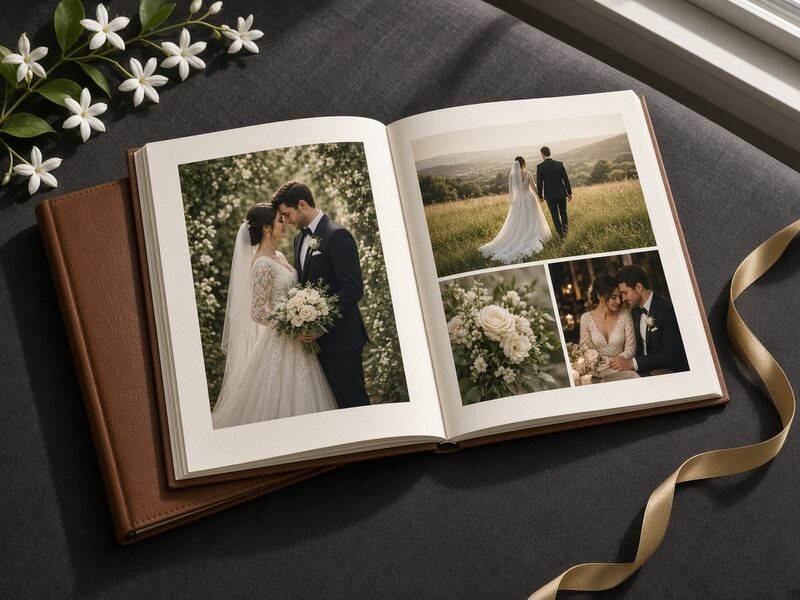
- The number of albums, their size, number of pages, paper and binding — and whether parents’ copies are included
- How files are delivered (online gallery, pen drive, both) and for how long they are kept
Albums in particular vary a great deal. A quote that looks lower may simply include a smaller album, fewer pages, or none at all.
Travel, stay and outstation weddings
A wedding in Guntur city costs a studio based here less to cover than one in another district. For weddings elsewhere in Andhra Pradesh — or further — quotes usually account for travel for the whole team and their equipment, stay if events run late or across days, and food on the day. Some studios include this in one figure, others list it separately. Either is fine, as long as you know which you are looking at.
If your venue is in Vijayawada, Amaravati, Tenali or Mangalagiri, mention it early. See areas we serve for how we plan travel.
Editing and delivery
The shoot is only part of the work. Selecting and editing a Telugu wedding carefully — balancing colourful hall lighting, keeping skin tones and silk colours true, building a highlight film around the mantras and the music — takes far longer than the wedding itself. Faster delivery, more edited photographs or more films all mean more editing time.
Ask each studio when you will receive a first look, the full set of photographs, the films and the album, and how many rounds of changes are included for the album design and films.
How to compare quotes fairly
Put the quotes side by side and check the same things in each:
| Check | What to look for |
|---|---|
| Events | Every event listed by name, with dates and places |
| Team | How many people, and who does candid, traditional, video and film |
| Hours | What “full day” actually covers, especially for early or late muhurthams |
| Photographs | Roughly how many edited photographs, and in what format |
| Films | Which films (teaser, highlight, full-length) and approximate lengths |
| Albums | Number of albums, size, pages, and whether parents’ copies are included |
| Travel | Included, or charged separately |
| Delivery | Timelines for photographs, films and album |
| Payment | Advance, balance, and what happens if your date changes |
Just as important: look at complete wedding galleries from each studio, not only their best twenty photographs. A highlight reel shows a studio’s best moments. A full gallery shows what your whole wedding will look like.
Questions to ask before paying an advance
- Who exactly will photograph and film our wedding? Will we meet them beforehand?
- Can we see one or two complete galleries from weddings similar to ours?
- What is included in writing — events, team, deliverables and timelines?
- What happens if an event runs longer than planned, or the muhurtham time changes?
- How is our footage backed up, and for how long do you keep our files?
- How many changes can we make to the album design and the films?
- What is the payment schedule, and what if our date moves?
A studio that answers these clearly and puts the answers in writing is a studio you can plan with. For a longer checklist, see our wedding photography planning guide.
Where to save, and where not to
If the first quote is more than you had planned for, there are sensible ways to bring it down without regretting it later:
- Cover fewer minor events rather than cutting team size at the muhurtham. The muhurtham happens once, and it is where coverage matters most.
- Choose one strong film instead of several short ones.
- Adjust the album — fewer pages or fewer copies — rather than the photography itself. Albums can also be ordered later.
- Combine events on the same day and venue where the family is comfortable doing so.
Where we would not advise saving: on the number of people covering a large muhurtham, and on experience. Rituals like Jeelakarra Bellam last seconds. A photographer who knows exactly where to stand for them is worth more than a longer list of deliverables.
If you would like a quote for your own wedding, send us your events, dates and venues. We’ll confirm whether we’re available, suggest coverage that fits your family and put everything in writing — so you can compare it fairly with anyone else’s.